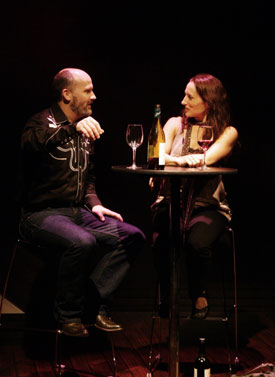
 Left - Glenn Hazeldine and Georgie Parker. Cover - Georgie Parker
Funny and discomfiting, occasionally sweet but more often just bitter (and certainly never bittersweet), Rhinestone Rex & Miss Monica could best be described as a romantic comedy for those who don’t really like romantic comedies.
As with some of his other recent work, David Williamson is making a bit of a departure from his long tradition of writing issue-driven plays, taking as his subject not corporate sociopaths, corrupt police, conservative shock-jocks, politicians or the literati, but instead simply two lonely people from very different walks of life.
Also fairly uncharacteristic for Williamson, this play is a two-hander, so there are to be no distractions or plot twists emerging from the antics of supporting roles, but rather a focussed unravelling of his two central characters as they stumble towards a relationship.
Fortunately, they are engaging creations, both being gradually revealed to be at once far more than they appear and yet they also turn out to be at heart very much as they first seemed. Monica is an irritably unsociable violinist forced into retirement by tendonitis, whose deep musical snobbery is brought to the fore when confronted by Gary, the gregarious Country and Western-loving tradesman she has contracted to renovate her kitchen, himself once a minor star in Tamworth before falling on hard times. Separated by class, temperament, and their tastes in not only music but just about every other aspect of life, they at first have virtually nothing in common other than loneliness. Indeed, despite their efforts to find common ground, it takes most of the play for them to discover even the smallest patch.
Were this simply the story of a country singer and a classical violinist coming to learn begrudgingly to appreciate each other’s music on the path to finding love, this would be a cute but ultimately thin play. Naturally though, Williamson takes it a lot further than that, and doesn’t conform to a lot of the RomCom conventions, but rather tampers with its traditional recipe. For instance, the extent to which Monica and Gary come to gain an ear for their respective musical tastes is decidedly uneven, and, unlike the common fashion in which the transformative power of love is shown to change the characters for the better, these two are relatively intractable in their manifold flaws, reaching no great epiphanies or compromises.
Similarly, Williamson makes an interesting inversion of the standard odd-couple type formula in which the conflicting characteristics of the pair are ultimately rendered unimportant (or even endearing) as more about them is discovered, revealing their better qualities. With Gary and Monica we get virtually the opposite, with their initially off-putting foibles being rendered insignificant by much bigger flaws that eventually come bubbling to the surface.
This could well be Williamson’s rebuttal to the implausibilities of the often saccharine genre he is tackling, or perhaps is his faintly cynical comment on the problematic nature of romance between comparatively mature adults for whom previous marriages and a lifetime of regrets have only served to reinforce bad habits and neurotic patterns.
One flaw in the play, albeit an admittedly quite subjective one, is that the roles engender a rather unequal amount of audience sympathy. While both characters are host to some fairly serious personal shortcomings, the way they are presented makes all the difference. One can’t help but feel that while objectively their moral deficiencies are roughly commensurate, their presentation is such that Monica comes across as far less sympathetic than Gary. Granted, this is in part an inevitable outcome of making their respective superficial characteristics to be abrasive and elitist versus friendly and populist, but the simple fact is that even though we discover some fairly unpleasant things about Gary too, our impression of Monica mostly just goes from bad to worse. Perhaps it is that most of Gary’s bad behaviour is merely recounted whereas Monica’s is more directly observed, allowing him to better retain our first impression of him being a “nice guy”.
Admittedly, one’s subjective response to this may well vary, possibly swayed to a lesser or greater extent by Australian gender stereotypes in which an irresponsible man with a tendency to bend the truth is somehow more acceptable than a hostile woman with somewhat compulsive habits regarding alcohol and sex. Much like the quality of the duelling genres of music in the play, how these characters’ human failings should be judged is very much in the eye of the beholder.
Of course one also cannot fail to take into account the influence of the actors’ performances in how these characters come across. Ensemble Theatre stalwarts Glenn Hazeldine and Georgie Parker are both excellent in bringing a very credible humanity to their respective roles, and under the direction of Sandra Bates have clearly found the right tone for the material that allows the drama to come through as neither trite nor heavy-handed by not overplaying the counterbalancing comedy. One can easily imagine, however, that different actors or simply different acting choices could perhaps have offset the aforementioned sense of imbalance in their characters’ appeal, and with only a slightly less glacial Monica or a marginally more sleazy Gary we might have had a surprisingly different dynamic.
Rhinestone Rex & Miss Monica is nothing groundbreaking, but is an interesting change of pace for Williamson and a subtle yet engaging twist on a well-worn genre.
Ensemble Theatre presents
Rhinestone Rex and Miss Monica
by David Williamson
Director Sandra Bates
Venue: Ensemble Theatre | 78 McDougall Street Kirribilli, NSW
Dates: 16 Sep - 20 Nov, 2010
Duration: 2 hours 15 minutes (including interval)
Tickets: $25.00 - $50.00
Bookings: 02 9929 0644 | ensemble.com.au